I like high yields. When I see 8% or 10% per year, it definitely catches my attention😊
However, the reason I seek high yields in real estate crowdfunding isn’t just because I’m happy to see my money grow significantly.
Since I am taking on risks for both the operating company and the property, I want a return that justifies it.This is the primary reason.
Even with low yields, there is a risk that the money won’t be returned
Real estate crowdfunding is convenient because you can choose properties, invest money, and leave the management to others.
However, in addition to the property risk of whether rent will be collected or if it can be sold at a high price, I am also concerned about the operating company’s cash flow and management status.
In the typical model where the operator themselves holds the property, even if the property value remains, if the company goes bankrupt, there is no guarantee that the money will be returned as planned. Basically, in most cases, the money will not be returned in the event of bankruptcy.
These burdens do not disappear just because the projected yield becomes lower.
It is difficult to decide based solely on numbers, such as ‘3% per year is safe’ or ‘10% per year is dangerous.’I think about whether I can be satisfied with this yield as a condition for entrusting my money to that company and property.
If a low yield is fine, I will consider other investment destinations
My goal is not to buy real estate crowdfunding itself.
I purchase it as a high-risk component of my own portfolio because it offers higher profitability.
There are other investment destinations such as stocks, J-REITs, and real estate digital securities. Each has different price movements, liquidity, taxes, and structures.
Basically, I believe that high-dividend stocks, J-REITs, and real estate digital securities have a relatively lower risk of the principal becoming zero, so they often have lower risk than real estate crowdfunding.
Therefore, my view is that if the yield range is low, these products are fine.
Among them, a major appeal I expect from crowdfunding is being able to aim for high returns.
I use 6% per year as a benchmark for crowdfunding yields.
However, there is no boundary of safety at the 6% figure.
I think about what I expect from the investment, including the addition of capital gains.
If there is no investment destination in crowdfunding that I can be satisfied with, I don’t have to force myself to allocate money to crowdfunding.I value this.
If the yield is the same, I also compare the structure of real estate STs
If I want to invest in real estate without following the daily market, I also compare real estate STs.
This is because I place great importance not only on the property’s earnings but also on how the invested assets are handled when a problem occurs at the operating company.
Even if the price is not displayed every day, the value of real estate fluctuates.
On that basis, there are mainly three reasons why I evaluate STs.
1. There are rules for information disclosure and sales
Real estate STs are sold in accordance with the rules of the Financial Instruments and Exchange Act, which is overseen by the Financial Services Agency. For public offerings aimed at the general public, you can check the structure and risks in the prospectus and disclosure documents provided during operation.
The fact that rules for information disclosure and explanation are in place so that investors can judge the structure and risks is also a reason why I evaluate STs.
② Assets can be separated from the company’s bankruptcy
In STs where assets are separated through trusts, etc., the structure is designed so that even if the operating company goes bankrupt, the investment property will not be caught up in the repayment of that company’s debts. This is ‘bankruptcy remoteness’.
Even though value remains in the property, it becomes difficult to recover if the company fails in another business. I value the fact that this reduces the paths that lead to such losses.

However, losses due to a decline in property value or borrowing to purchase the property remain. There is a possibility of losing the entire principal even with an ST, and it cannot be said that ‘the loss will be at most X%’. Some crowdfunding products also have bankruptcy remoteness.
③ The treatment of after-tax profits and losses is also different
For public trust-type STs, the tax rate on profits is generally 20.315%. If certain conditions are met, realized losses can be offset against profits from listed stocks, etc., or carried forward for three years from the following year. This is a mechanism that can reduce taxes on other target profits.
On the other hand, profits from general anonymous partnership-type crowdfunding are generally treated as miscellaneous income and subject to comprehensive taxation. The tax burden changes depending on your income. It is not uniform even for STs, and renga is treated as this miscellaneous income.
The tax system is not a mechanism to protect principal, but I want to compare them including the profit remaining in hand and the tax burden after a loss occurs. The target products and filing conditions for the tax system are summarized in Tax comparison between crowdfunding and digital securities.
If the yield is comparable to an ST with such a structure, I believe there is a reason to choose the ST. That is why I want to seek high returns from crowdfunding that are enough to take on the risks of the company and the property.
Comparisons between low-yield crowdfunding and STs/J-REITs, etc., are explained in detail in articles comparing other investment targets.
The loss when failing can be greater than the difference in yield
On the other hand, I do not think that ‘as long as the yield is high, it is good’.
For example, if you invest 100,000 yen for one year, it is 6,000 yen at 6% per year, and 10,000 yen at 10% per year. If distributed as planned, the pre-tax difference is 4,000 yen.
However, if you lose 30% of your principal, the loss will be 30,000 yen.

Of course, if the yield is different, the content of the project is also different. What I want to convey in this example is that if you are captivated by a difference in yield of a few percent, you will underestimate the possibility of a large loss.
Therefore, along with “what percentage I might get if things go well,” I also consider how much I am likely to get back if things do not go well.
Even with high dividends, it does not necessarily mean that a large loss of principal can be covered. For this reason, I seek higher yields when investing in products with higher risks in the event of an emergency.
What I want to look at is the value of the property, the company’s finances, and information disclosure.
For example, a building that generates rent versus land whose value increases significantly only after a project succeeds. Even at the same 8% per year, what remains when the plan collapses is different.
There are mainly three things I want to look at before investing.
Is the offering amount too large relative to the value of the property?
If the price incorporates future success, I am also concerned about recovery if that does not materialize.
Are the company’s finances sustainable?
In addition to whether they are profitable, I also look at their cash on hand, borrowings, and ongoing projects. Even if they explain that they “plan to buy it back themselves in the end,” whether they can actually prepare those funds is another matter.
Do they provide the necessary information?
Rather than how good they are at communicating, I want to see if they disclose unfavorable information and answer questions specifically.
However, there are times when I invest in projects that still have weak points or parts I do not understand.
With that in mind, I think, if I am going to accept this uncertainty, then at this yield, up to this amount. That is how I choose.
Recently, in my analysis of GATES FUNDING No. 33, I focused not only on the 14% annual figure but also on how the dividends are earned and the final sale.
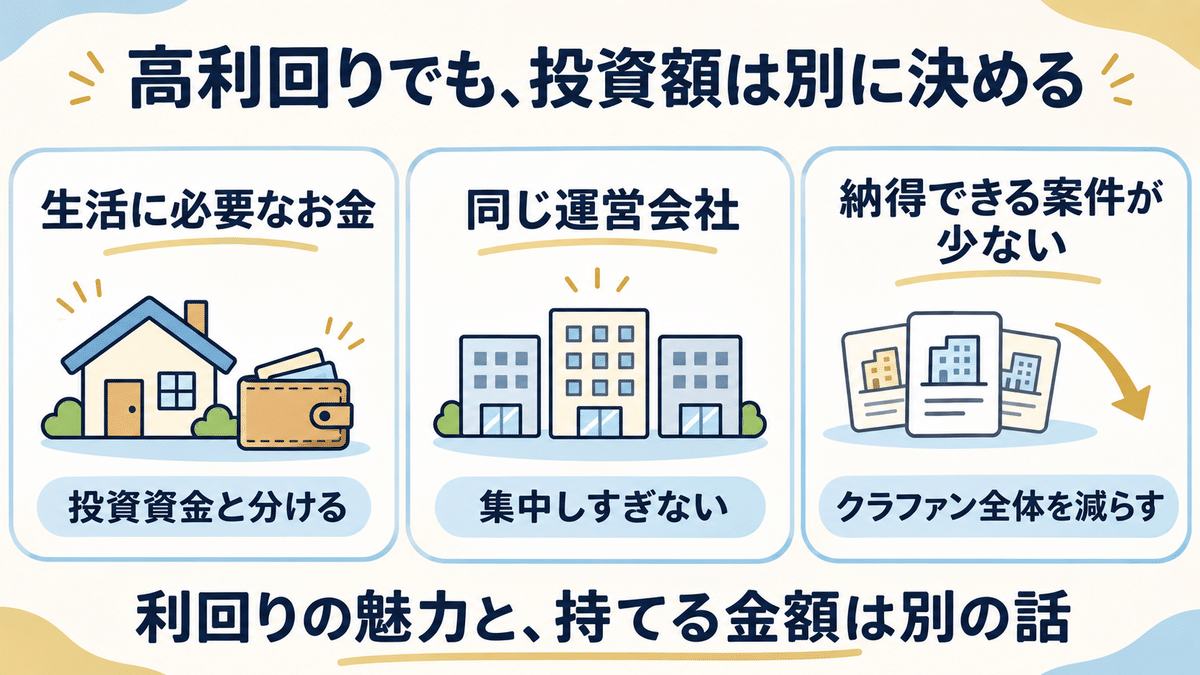
I keep my investment amount low precisely because I am aiming for high returns.
While I continue to build assets for the future through methods like accumulation, I aim for dividends and high returns through crowdfunding. This is because I also want to spend money on my current life and time with my family.
However, I want to avoid concentrating too much capital in companies I feel attracted to.
If I hold multiple funds from the same company, even if the properties are different, the risk of the company’s management deteriorating overlaps.
Even when the number of reliable operators decreases, rather than concentrating on the one remaining, I would lower the ratio of crowdfunding as a whole.
I aim for a total positive return, including not just the dividends I receive but also any losses. To that end, I want to keep the amount at a level where a single failure or delay in redemption will not affect my daily life.

I have summarized how to use NISA for asset building and crowdfunding separately in my blog.
Look at the yield to get interested, research the property and the company, and finally decide on the amount. I will continue to write my future fund analyses based on this way of thinking.😊
Three pages you can use when looking for investment opportunities
My investment plans and information on offerings from various companies are summarized here.
Information on the author’s investment plans and funds under consideration
I have summarized the projects I am currently interested in and the ones I plan to apply for.
List of companies where you can register for special benefits
You can check registration and first-time investment benefits along with their eligibility conditions.
Use this when you want to check each company’s offering schedule, expected yield, and investment period by date.
*Investment carries the risk of principal loss and redemption delays. Please view this, including my planned investments, as one piece of information for your decision-making. Please check the latest official information regarding offering status and benefit conditions before applying.