The theme for this time is the ‘subordinated investment ratio’ in real estate crowdfunding!
First of all, are you familiar with the term ‘priority-subordination structure’?
Some of you may already know this, but we have prepared a simulation of what would happen if a loss were to occur, using the ‘T’s Funding T-20 Fund’ which was actually operated as planned, so we hope you will read until the end.
To begin with, what is a ‘priority-subordination structure’?
When researching real estate crowdfunding, you may have seen explanations such as, ‘If a loss occurs due to the priority-subordination structure, the business operator will bear it, so your principal will not be impaired up to a certain amount.’
In summary, this refers to a ‘mechanism where, if a loss occurs, the subordinated investor (the business operator) bears the loss before the principal of the priority investors (general investors) is affected.’
In other words, the higher the ratio of ‘subordinated investment,’ the higher the probability that your priority investment capital will not be affected even if a large loss occurs.
Therefore, the ratio of subordinated investment is a very important indicator when considering the investment risk of real estate crowdfunding.
Specific examples of ‘losses’ that could occur include: a tenant moving out of a rental unit resulting in no revenue, unexpected repairs occurring, or the property being sold at a lower price than planned, among various other possibilities.
Now, if a loss occurs, how does the money decrease?
Of course, as the business operators conducting the management, we want to avoid such situations as much as possible. However, we must also anticipate situations where unexpected losses may inevitably occur.
*It is prohibited to solicit investment products using expressions that imply that the principal is guaranteed or that the yield is fixed.
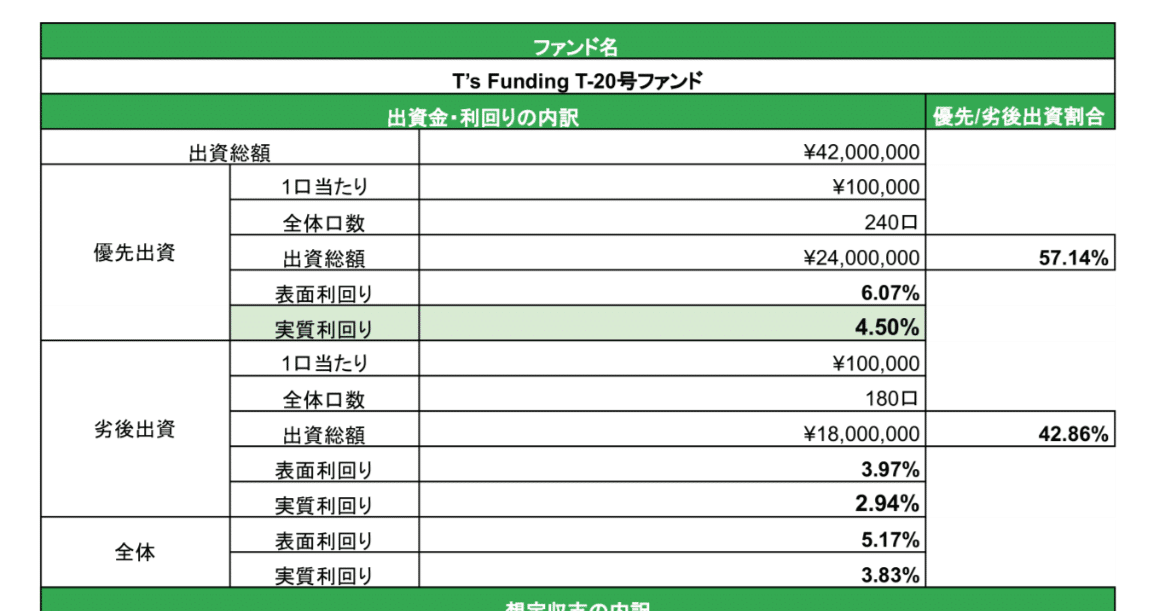
Using the simulation of the actually operated ‘T’s Funding T-20 Fund’ as an example, we will explain how funds move when a loss occurs!

(Reference: ‘T’s Funding T-20 Fund’ Distribution Simulation)
At ‘T’s Funding,’ we summarize and disclose the breakdown of investment funds and revenue forecasts as a ‘distribution simulation’ to our members before the investment application period begins.
In the case of the ‘T’s Funding T-20 Fund,’ the priority investment amount is 24 million yen with a priority investment ratio of 57.14%, and the subordinated investment amount is 18 million yen with a subordinated investment ratio of 42.86%.
Also, separate from this, there is the revenue (i.e., distributions) earned during operation.

For all ‘T’s Funding’ funds, if a loss occurs, funds will decrease in the following order (as of March 28, 2025).
① Distributions from subordinated investment: 267,110 yen
② Distributions from priority investment: 554,320 yen
③ Subordinated investment capital: 24,000,000 yen
④ Priority investment capital: 18,000,000 yen
*Amounts are for the ‘T’s Funding T-20 Fund’
This means that the investment capital only begins to be used after all profits earned during the operation period have been exhausted.
At ‘T’s Funding,’ based on the initial simulation, if expenses are higher or revenue is lower than the 267,110 yen in distributions from subordinated investment (①), it will begin to affect the distributions from priority investment (②). If further losses occur even after all distributions are exhausted, the business operator will bear the loss up to the 24,000,000 yen of subordinated investment capital, and if losses exceeding that occur, the investor’s principal (priority investment capital) will begin to be affected.
That said, real estate is generally considered an investment product that can provide relatively stable returns if managed appropriately.
*As of the end of October 2026, ‘T’s Funding’ has no track record of the (2) priority investment distribution falling below the projected distribution rate.
Investing is not a
dream-like service where money just grows if you leave it alone.
It is something where you can only earn a return by taking on various risks and managing them appropriately.
It is painful for us as a product provider to share this kind of information, but investing always carries risks.
Please be very careful with products that avoid detailed explanations and emphasize only stability or returns.
We would like you to acquire sufficient knowledge about investing and make your investment decisions carefully.
Thank you for reading this far.