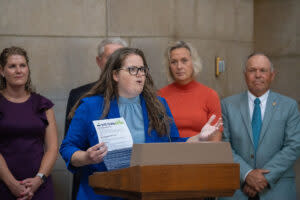
A University of Arizona cancer research lab, facing difficulties in getting federal funding, has started a crowdfunding campaign to raise money for its work.
The cancer research lab — led by Joyce Schroeder, a UA professor of molecular and cellular biology — has had smaller pockets of funding from internal university grants to keep her lab going. However, they are still “between federal funds right now,” which is where the “big dollars come from” to do major research projects, she said.
Schroeder’s lab specializes in metastatic breast cancer research, including the investigation of a protein called “Epidermal Growth Factor Receptor,” which is a big driver of all types of cancer, not just breast cancer. Her research, which started two decades ago, is about studying the specific behavior of this protein that drives breast cancer and developing a drug that can block that behavior.
People are also reading…
Schroeder told the Arizona Daily Star on Monday that “federal funding for cancer research is always difficult to get,” not just in the current Trump administration.
“So typically, the pay line for the type of grants that fund the research I do is around 7%. So, that means 93% of all cancer researchers out there who are applying for these grants are rejected, just simply because there’s not enough money to go around for all the ideas out there,” Schroeder said.
“We, as a nation, put up a lot of money historically into cancer research, a lot more than other nations. But it’s still a very, very small amount when you think about how much needs to be done to address the problem,” she continued. “… Despite that, we’ve still been successful over the last few decades. But recently, in the last couple years, it’s been really difficult, and we haven’t been able to get a federal grant.”
Schroeder said the crowdfunding initiative, a GoFundMe fundraiser which started off as a joke, was created by one of the PhD students in her lab, Danielle DiFranco, after speaking with her family about how hard it was to obtain research funding. All the credit for the fundraiser, which has raised about $5,030 as of Friday, goes to DiFranco, Schroeder said.
DiFranco said she was discussing the struggles of finding funding with her mom, who has several relatives who have had breast cancer and were interested in donating money. This is when her mom floated the idea of starting a GoFundMe page, so they had one source to collect all the donations.
“The type of breast cancer that we study does not have a lot of great treatments currently,” said DiFranco, who is in her third year of working on a PhD and being a part of Schroeder’s lab. “There are some targeted treatments depending on each individual person, but it’s really like chemotherapy and stuff is the main standard of care, which is really hard on the body, hard on the people who have to go through it. So, we’re trying to develop therapies that would be more targeted and less harmful to patients. Our goal is to help people.”
DiFranco said the biggest thing that she’s grateful for are that people are willing to donate.

University of Arizona PhD student Danielle DiFranco organizes a GoFundMe fundraising campaign for her cancer research lab, which is led by Joyce Schroeder, head of the molecular & cellular biology department at the UA. Their lab conducts research on metastatic breast cancer research, including the investigation of a protein called “Epidermal Growth Factor Receptor” which is a big driver of all types of cancer, not just breast cancer.
“I know a lot of people have personal stories about breast cancer or other cancers, and our goal is to help them,” she said. And it’s just nice to get some publicity on the fact that the scientific research world is hurting in the state of the U.S. right now.”
About the fundraising initiative, UA spokesperson Mitch Zak said while the UA Foundation is not intended to fund large-scale university research, it maintains a crowdfunding platform for faculty, departments and other campus community members with “mission-driven projects and an engaged base of potential supporters.”
“In fiscal year 2025, the Foundation hosted more than 20 crowdfunding projects led by faculty and students, raising $220,500 to support a wide range of efforts, from Campus Recreation to college-based initiatives,” Zak said.

University of Arizona PhD student Danielle DiFranco organizes a GoFundMe fundraising campaign for her cancer research lab, which is led by Joyce Schroeder, head of the molecular & cellular biology department at the UA. Their lab conducts research on metastatic breast cancer research, including the investigation of a protein called “Epidermal Growth Factor Receptor” which is a big driver of all types of cancer, not just breast cancer.
The crowdfunding money will be put towards buying lab supplies in Schroeder’s lab. As for the salaries of the two PhD students and three undergraduate students working in her lab, she said PhD students are typically funded through federal grants, teaching assistant positions where they teach classes in addition to doing their research, and scholarships and fellowships.
DiFranco was being paid by UA’s Cancer Center till the end of the summer and now has been awarded a UA fellowship to pay her salary for the next year, while the other PhD student is being paid through a teaching assistant position. Finally, the three undergraduate students in her lab are getting course credit for their work.
The Arizona Cancer Center was founded almost 50 years ago, and is one of just 57 such centers nationwide, said UA’s Senior Vice President for Research and Innovation Tomás Díaz de la Rubia. He said the UA is proud to be home to one of the nation’s premier cancer research enterprises, anchored by the only NCI-designated Comprehensive Cancer Center headquartered in Arizona.
Schroeder said that lots of federal agencies fund science and research in general. However, Díaz de la Rubia said external funding for cancer research to the center comes from federal sources like the NCI, an institute within the National Institutes of Health, and the U.S. Department of Defense, as well as private sources such as the American Cancer Society and multiple foundations.
Schroeder is now waiting for one grant application submitted with the Department of Defense to move forward on the development of the drug that blocks behavior driving breast cancer. Additionally, they were also attempting to identify patients suitable for receiving the drug through grant money from the Food and Drug Administration.
Mapping her journey of developing this drug in the last 20 years, Schroeder said there had been three attempts with different grants to develop the drug through funding from several sources over time, including NCI, the DOD and investors as well.
Schroeder said the third drug development attempt is the one they’re currently working on, after learning from the first two attempts, and that “it looks fantastic.”
Schroeder said the third attempt was successful since they made this discovery that the drug is activating the immune system. After this, they submitted a grant for follow-up research with NCI, who said this is a good idea, but they needed more proof in the form of pilot data that would tell them if this is a good place to invest taxpayer money. At this point, UA’s Cancer Center stepped in and offered them a small pilot grant of $30,000 in February this year to do minimal experiments and find out if the drug is working.
Schroeder said $15,000 of UA’s Cancer Center pilot grant had been spent so far, and the results of the research showed the drug was working the way they hypothesized. And so, they reapplied to the defense department with new data to get the full federal funding.
Speaking of impacts of the current federal funding turmoil, Schroeder pointed to the DOD capping indirect cost reimbursement rates for higher education institutions at 15% May 14, and said this will affect her research if her grant application is approved. The defense department’s cap comes after NIH and NSF moved to put the same 15% cap in place.
Schroeder said the DOD cap would bring indirect costs at the UA down from about 55%.
“The translation of that is there is less money in the grant to do the actual research. So, it (would) cut the amount of actual research that I could do by about a third,” she said.
“So, you know, as I’m designing the experiments that we were proposing to do, I couldn’t design all that I thought needed to be done. I had to look at the budget and say, ‘Well now, we can only afford a third less of those experiments.’…We’ll do our best to get as much information we can, but it’s less than we would have otherwise. And that’s disappointing.”
Speaking of the significance of science and research, Schroeder said the research she does in her lab is very applicable to people and their lives.
“We’re not just understanding what’s going on with cancer. We’re trying to develop therapies to treat people. So, we have a strong translational arc in our lab and the research we do, and we’re trying to directly impact people’s lives by developing treatments for cancer,” she said.
Reporter Prerana Sannappanavar covers higher education for the Arizona Daily Star and Tucson.com. Contact her at psannappa1@tucson.com or DM her on Twitter.