Real estate crowdfunding is not a product where principal or distributions are guaranteed. In this article, we will organize the six risks you should know before investing, and then introduce actual cases published by administrative agencies and business operators, following the descriptions in the public documents.
Key points of this article
There are 6 main risks
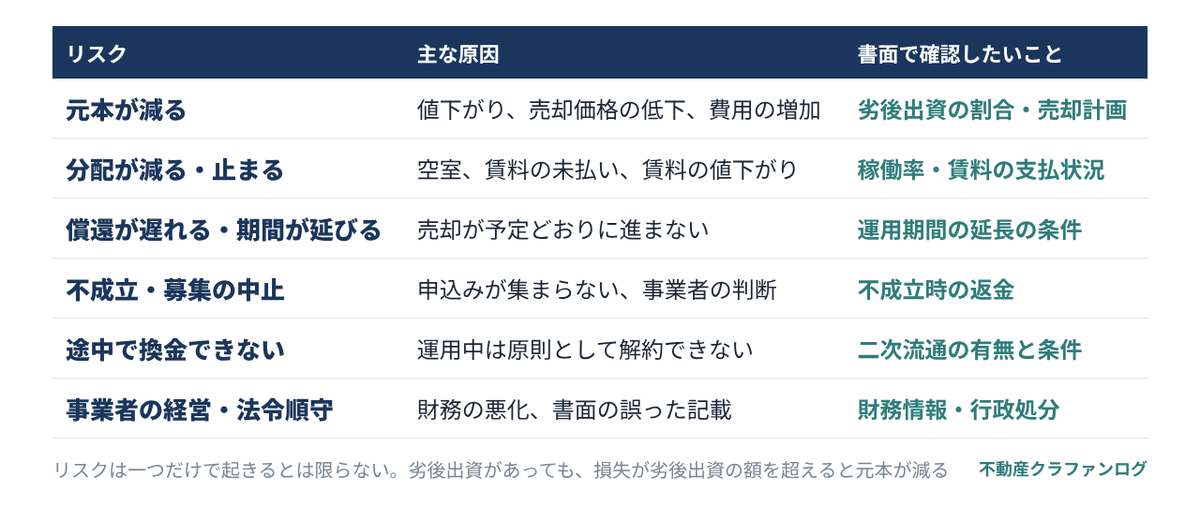
These are: principal loss, reduced or stopped distributions, delayed redemption, failure of the fund to form, difficulty in liquidating mid-term, and issues with the operator’s management or legal compliance.
In September 2026, the licenses of two companies involved in “Minna de Oya-san” were revoked
The Tokyo Metropolitan Government and Osaka Prefecture issued orders to revoke the real estate specified joint enterprise licenses and issued instructions to the sales agent and the business operator, respectively.
Risk explanations can be confirmed in writing, but they cannot predict the future
While it is important to read the risk explanations and contract terms in the pre-contract documents, it is not possible to fully foresee losses or delays in advance.
Main risks of real estate crowdfunding

1. Principal loss
The money returned may be less than the invested amount due to a decline in property value, lower-than-expected sale prices, or increased costs. In funds using the priority-subordinate system, the subordinate investment (the portion provided by the operator, etc.) bears losses first within the scope determined by the contract. However, if the loss exceeds the amount of the subordinate investment, the investor’s principal will also decrease. The subordinate investment is a mechanism to absorb losses and does not guarantee the safety of the principal.
2. Distributions decrease or stop
Distributions may decrease or stop due to a decline in rental income, insufficient profit from sales, or increased costs. The expected yield is not a guaranteed yield.
3. Redemption is delayed or the operation period is extended
If sales, development, or fund recovery do not proceed as planned, the operation period may be extended or the return of principal may be delayed. It is necessary to distinguish between an “extension,” where the operation period is extended according to the contract, and a “redemption delay,” where payment is not made even after the payment due date.
4. Failure to form or cancellation of offering
A fund may not be formed due to reasons such as insufficient applications or changes in the business plan. Generally, the amount for which the fund was not formed is refunded according to the contract or service regulations, but it is necessary to check the timing and method. Unlike the risk of principal loss after operations have begun, this is a risk closer to having your money temporarily tied up or missing out on investment opportunities.
5. Difficulty in liquidating mid-term
In principle, many funds under operation cannot be freely canceled or liquidated. Whether equity can be transferred or traded on a secondary market, and the conditions for doing so, vary by fund.
6. Operator management and legal compliance
Deterioration in the operator’s finances, deficiencies in fund management, or inaccurate information disclosure can affect investment decisions and fund recovery. How cases are handled if an operator goes bankrupt depends on the form of the contract and the method of asset management. Being licensed by the government does not mean that the principal is guaranteed.
What actually happened (1): Administrative actions

If a business operator violates laws and regulations, the administrative agency that issued the license (the Ministry of Land, Infrastructure, Transport and Tourism or prefectural governments) will take action and make it public. Major recent examples are as follows.
・June 17, 2024: Tokyo Metropolitan Government
Issued a partial business suspension (30 days) and instructions to Minna de Oya-san Hanbai Co., Ltd. According to the Tokyo Metropolitan Government’s announcement, the reason was that although the target property included land not subject to development permission, the pre-contract and contract documents stated that development permission had been obtained, which was contrary to the facts.
・September 1, 2026: Tokyo Metropolitan Government
Revoked the license and issued instructions to the sales agent, Minna de Oya-san Hanbai Co., Ltd. (Tokyo Governor License No. 76). According to the Tokyo Metropolitan Government’s announcement, the reasons included that although rent had not been paid by tenants for a certain period for the target property, the “Rent Payment Status” column in the pre-contract document was filled out as “Not Applicable” and delivered/explained as such, and that the company repeated similar violations after the 2024 action.
・September 1, 2026: Osaka Prefecture
Revoked the license and issued instructions to the business operator, Toshi Soken Invest Fund Co., Ltd. (Osaka Governor License No. 8). In the Osaka Prefecture disposition document, the reasons cited include that net assets did not meet the licensing criteria, the delivery of documents containing facts contrary to the rent payment status, the failure to pay by the redemption date for 9 products (7,511 business participants, 18.802 billion yen), and that it is extremely difficult to return the full amount by the due date for 29 products scheduled for redemption.
The two companies are involved with the same “Minna de Oya-san” brand, but their roles (sales agent and operator) and the administrative agencies that issued the disciplinary actions are different.
Even if a license is revoked, contracts already entered into do not immediately cease to exist, nor are invested funds automatically returned. The Osaka Prefectural Government explains that even if a license is revoked, if business based on a contract has not been completed, the entity is still considered a real estate specified joint enterprise to the extent necessary to complete that business.
The business operators also issued announcements on the same day. While they take the disciplinary action extremely seriously and apologize for the delays in distributions and redemptions, they explain that they do not share the same views as the administrative authorities regarding all the facts and legal assessments, and that they are contesting the legality of the 2024 disciplinary actions through judicial proceedings. They state that they will continue to perform the work for existing contracts until completion.
The Real Estate Crowdfunding Association explains that the two companies that received disciplinary actions are not members of the association. However, whether or not a company is a member of the association does not in itself determine the safety of individual products. Furthermore, this log treats these products as “reference” and does not include them in the market aggregation of funds solicited online.
In addition, the Osaka Prefectural Government is calling for caution against suspicious solicitations or communications that promise “refunds” of invested capital. They state that any communication requesting the purchase of other investment products or advance payment of fees for the purpose of a refund may be a scam.
What Actually Happened ② Extension of Investment Period
Extensions of investment periods are sometimes announced on fund pages or through operator notices.
For example, GOLD CROWD (Gold Trust Co., Ltd.) announced extensions for two funds related to grid-connected storage facility project sites (August 27, 2026: 7-month extension; October 30: 6-month extension). The announcements cite that they were informed by the purchasing company that grid connection adjustments are taking longer than expected. It is also noted that the sale price is determined by contract and that dividends are expected to be as initially projected in terms of annual yield.
An extension does not necessarily mean that the principal will decrease. On the other hand, it also does not guarantee that the sale or distribution will be realized as scheduled in the future. Progress following an extension can be confirmed through follow-up reports from the operator.
What Actually Happened ③ Failure to Launch / Suspension of Solicitation
According to this log’s records, among the funds that began solicitation between January and October 2026, there were 5 funds (totaling 1.45 billion yen in solicited amount) that were confirmed to have labels such as “failed to launch” or “solicitation suspended.” The breakdown is 3 funds (from 1 service) labeled as “solicitation suspended” or “solicitation cancelled,” and 2 funds (from 2 services) labeled as “failed to launch” (records as of November 16, 2026).
The reasons and handling of funds can differ between “failed to launch” and “solicitation suspended.” The timing and method of refunds can be confirmed through the guidance provided by each service.
Things to Check Before Investing
・Loss burden: Presence and ratio of priority/subordination, and under what circumstances the principal decreases
・Basis for returns: Assumptions for rent or capital gains, and their premises
・Exit and duration: Status of buyers and sales contracts, conditions for extension, and scheduled redemption date
・Conditions for liquidation: Whether mid-term cancellation, transfer, or secondary trading is possible
・Operator: Financial statements and financial information, fund management methods, and administrative actions or important notices
・In case of failure to launch: Method, timing, and fees for refunding deposited money
Information on administrative actions can be checked on the Ministry of Land, Infrastructure, Transport and Tourism’s “Negative Information Search Site” or through press releases from prefectural governments.
About this article
This article organizes the types of risks and published cases based on public documents from administrative agencies, official announcements from operators, and records from this log. It does not evaluate the safety of individual operators or funds.
・Sources: Tokyo Metropolitan Government “Regarding Administrative Actions against Real Estate Specified Joint Enterprises” (June 17, 2024, September 1, 2026), Osaka Prefectural Government press releases (September 1, 2026) and disciplinary documents
・”Regarding Alerts Concerning Real Estate Specified Joint Enterprises” (updated August 25, 2026), announcements by Minna de Oya-san Hanbai Co., Ltd. (September 1, 2026), Real Estate Crowdfunding Association “Regarding Administrative Actions against Certain Operators” (September 3, 2026), GOLD CROWD official website notices (August 27 and October 30, 2026), and this log’s Fund DB (records as of November 16, 2026)
This article does not recommend investing in any specific operator or fund.