The discount rate for crowdfunding early bird offers (limited-quantity discounted rewards available only to backers immediately after launch) should be determined by calculating backward from “how much profit remains per unit” rather than “how much of a discount will make it sell.” Determine the upper limit of the discount rate based on the remaining profit, divide the tiers into 3 to 5 levels, and set the quantity for the deepest tier to cover 30% of the target amount on the first day of the launch. Distribute the duration so that the deepest tier disappears within 3 days of the launch, while the shallowest tier remains until the end date. This article provides a step-by-step guide for product sellers who launch crowdfunding or pre-order campaigns monthly on how to perform these calculations themselves, and how to prevent the “habit of making discounts too deep,” which is a common pitfall for those who run campaigns frequently.
Why you lose money with discount rates

There are two ways to lose money with early bird discounts. The first is that the discount is too deep, causing your profit to vanish. A Makuake article cites a failure example where, with a reward price of 5,000 yen, a cost of 2,500 yen (50%), shipping of 800 yen, and a 20% commission of 1,000 yen, only 700 yen remains (Makuake “How to Design Rewards Without Failing in Crowdfunding” https://lp-mk-2.makuake.com/article/072 ). Every time you deepen the discount rate by one tier, the commission decreases in proportion to the price, but shipping and production costs do not decrease by even one yen. Therefore, your profit disappears at a much faster pace than the discount rate figure suggests.
The second is that the discount is too shallow, failing to generate initial momentum. A Makuake article states that projects that raise 30% or more of their target amount within 24 hours of launch have a 95% success rate, and it is recommended to structure early bird rewards so that their total amount meets nearly 30% of the target (Makuake “Techniques for Reward Design: How to Use ‘Early Bird’ and ‘Set Discounts'” https://lp-mk-2.makuake.com/article/038 ). The same article also notes that backers “tend to purchase the single-item rewards with the highest discount rates first.” In other words, the effectiveness of an early bird offer is determined not by the discount rate itself, but by whether “quantity × price equals 30% of the target.”
For those who launch monthly, there is a third type of loss. If you offer a deeper discount than the previous time, previous backers will wait, thinking “it will be cheaper next time,” and you will be forced to lower your general retail price as well. The Makuake article points out that reward designs that only offer products cheaper than the list price make it difficult to set prices for general sales and only attract backers who “buy because it’s cheap,” failing to build a fan base (article/072 above). The more often you run campaigns, the more you need the discipline to “fix an upper limit” on your discount rates.
Steps to do it yourself

As an example, let’s consider a product with a planned general retail price of 12,000 yen (including tax and shipping), a cost of 3,600 yen (30% cost ratio; a benchmark figure from the Makuake article, article/072 above), and shipping of 800 yen per unit. These numbers are hypothetical, so please replace them with your own product’s figures.
1. Create a list of remaining profit for each discount rate and decide on the “discount rates you will not use.” Remaining profit is “Reward Price × (1 − Commission Rate) − Shipping − Cost.” The commission is 20% for Makuake (example from article/072 above) and 17% of the total support amount for CAMPFIRE (12% commission + 5% payment processing fee) plus consumption tax (CAMPFIRE service document https://lp.camp-fire.jp/rs/422-RMC-653/images/CAMPFIRE_service.pdf ). Calculating with Makuake’s 20%, a 20% OFF price of 9,600 yen leaves 3,280 yen, 25% OFF at 9,000 yen leaves 2,800 yen, 30% OFF at 8,400 yen leaves 2,320 yen, 40% OFF at 7,200 yen leaves 1,360 yen, and 50% OFF at 6,000 yen leaves 400 yen. Here, set your own lower limit in one line, such as “I will not use discount rates where the remaining profit falls below 1,000 yen.” In this example, the upper limit is 40%, and 50% will not be used. This single line is the foundation for all future decisions.

2. Divide into 3 to 5 tiers and align the shallowest tier with the general retail price. The Makuake article recommends dividing discount tiers into “roughly 3 to 5 levels” and keeping the number of rewards to within 10 (Makuake “What are the key points for rewards that determine the success or failure of crowdfunding?” https://lp-mk-2.makuake.com/article/009 ). In the example, we use 3 tiers: Super Early Bird 30%, Early Bird 25%, and Regular Discount 20%. Shifting the discount rate by 5 percentage points makes the price difference between tiers clear and easier to choose. The shallowest tier is introduced as a “Makuake Price” with the lowest discount rate, close to the general retail price (article/038 above). This serves as a bridge to the price you will sell at on your own e-commerce site after the campaign ends. The upper limit discount rate decided in Step 1 is used only for the deepest tier.
3. Calculate the quantity for the deepest tier backward from 30% of the target amount. If the target amount is 600,000 yen, 30% is 180,000 yen. For a Super Early Bird price of 8,400 yen, 180,000 yen ÷ 8,400 yen is about 21 units; let’s round it to 20 units. If the target is 1 million yen, 300,000 yen ÷ 8,400 yen is about 36 units, so you would set the Super Early Bird to 20 units and fill the remaining 130,000 yen with Early Bird (9,000 yen × about 15 units). Keep in mind the number of people likely to act on the first day, such as previous backers or newsletter subscribers, and verify if “this is a quantity that will truly sell out on the first day.” A “limited” offer that doesn’t sell out does not function as a limited offer.
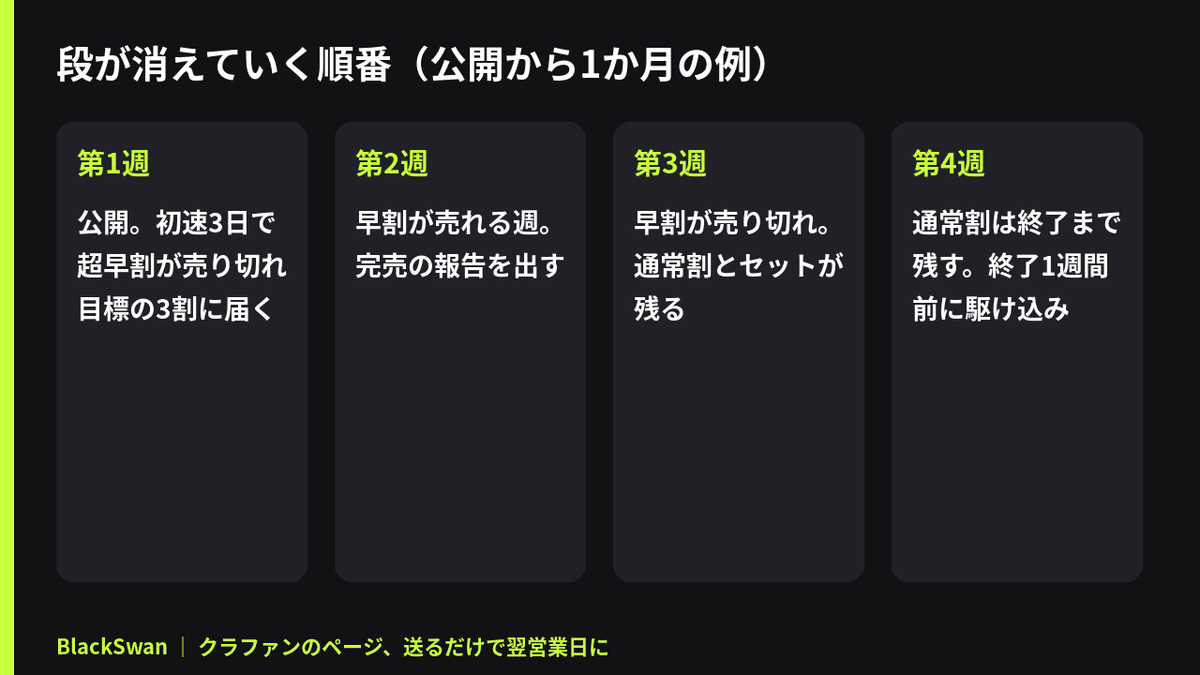
4. Decide the order in which tiers disappear according to the duration. The recommended duration for Makuake is 2 to 3 months (Makuake Help https://lp-mk-2.makuake.com/help/306 ), and it is said that support purchases are most likely to gather during the “initial momentum period” of about 3 days from launch and the “last spurt period” from one week before the end (Makuake “What are the optimal project duration and points for ‘Makuake’?” https://lp-mk-2.makuake.com/article/014 ). In line with this, distribute the Super Early Bird to sell out in the 3-day initial period, the Early Bird to sell out in the 2nd to 3rd week, and leave the Regular Discount with no quantity limit until the end date. Since rewards cannot be changed after launch (article/009 above), you can prevent the situation where no tiers are available until the end by having at least one tier with no limit.

5. For set discounts, make the price per unit lower than the Super Early Bird. The Makuake article states that it is important to design prices so that people consider, “If I’m going to buy it anyway, should I buy multiple for 14,000 yen instead of one for 8,000 yen?” (article/038 above). In the example, a 2-piece set at 16,800 yen (8,400 yen per unit) is the same as the Super Early Bird, so lower it slightly to 16,000 yen (8,000 yen per unit). Because shipping costs per unit decrease with combined shipping, calculating with the formula from Step 1 often results in more remaining profit than a single item, and it also serves as an “escape route” after the Super Early Bird sells out.
6. If you launch monthly, fix and record the upper limit of the discount rate for your product line. If the previous Super Early Bird was 30%, keep it at 30% this time as well, and respond to existing backers with “securing quantity” rather than “deeper discounts.” Do not lower the general retail price until the next time. If you keep a single table recording the discount rate, price, quantity, remaining profit, and the day it sold out, you can finish the design next month just by swapping the numbers. If the Super Early Bird didn’t sell out in the first 3 days, reduce the quantity next time, not the discount rate. This is the easiest way to prevent the habit of making discounts too deep.
7. Check all tiers in the table before launching. Check whether the remaining profit for all tiers is in the black, whether the total of the deepest tier and the Early Bird reaches 30% of the target, whether the last digit of the price is 0 and below a major threshold like 9,990 yen (article/009 above), whether the discount rate and quantity are written on individual reward images (same article), and whether delivery is within six months of the project end (same article). Since you cannot fix it after launch, stopping here is the final move to avoid losses.
On the page, post this table as is in the “Reward Sheet” and “Caution Sheet”

Once the design table is complete, post the same numbers in the page body. If you create the page by dividing it into slides like “Cover, Issues, Solutions, Features, How to Use, Specifications, Story, Rewards, Flow, Cautions, FAQ,” the Reward Sheet just requires lining up the table from Steps 2-5 vertically, and the Caution Sheet only needs two lines: “Rewards cannot be changed after launch” and “Includes shipping and tax.” When BlackSwan creates a page, this is the method used. For those who launch monthly, reusing this 11-slide template and only swapping numbers and photos next month makes both reward design and page production a matter of “updating the table.”
Estimates for time and costs
If you do it yourself, it usually takes 1 hour for the list in step 1, 1 hour for assembling steps 2-5, and 1 hour for steps 6 and 7, totaling 2-3 hours from the second time onwards. For the first time, it takes an additional 1-2 hours to finalize the general retail price and cost. This is a part that you must decide yourself even if you outsource the rest. On the other hand, if you outsource the task of putting the finalized table onto the page, i.e., the entire page production, the market price is about 100,000 yen with a lead time of 2 weeks to 1 month (based on individual listings on Coconala and public rates of production companies as of October 2026).

If you are launching every month, you can let go of the production work
If you outsource page production, the market price is about 100,000 yen with a lead time of 1 month (based on individual listings on Coconala and public rates of production companies as of October 2026).
If you launch crowdfunding or pre-orders more than once a month, BlackSwan, which costs 7,980 yen per month for 6 projects and delivers slides by the next business day, only costs 1,330 yen per project. You can edit the text, colors, and order yourself.

First, please check if it is a good fit during a 15-minute free consultation.
→ https://ssskobj-dev.github.io/blackswan-site/
I will write about how to create an early bird table into a return image that can be chosen at a glance in the article ‘Crowdfunding Return Images’. How to communicate early bird sell-outs during the campaign to grow your page is summarized in ‘How to Write Crowdfunding Activity Reports’, and the basics of combining three price tiers with early bird discounts are summarized in ‘Crowdfunding Return Design’.