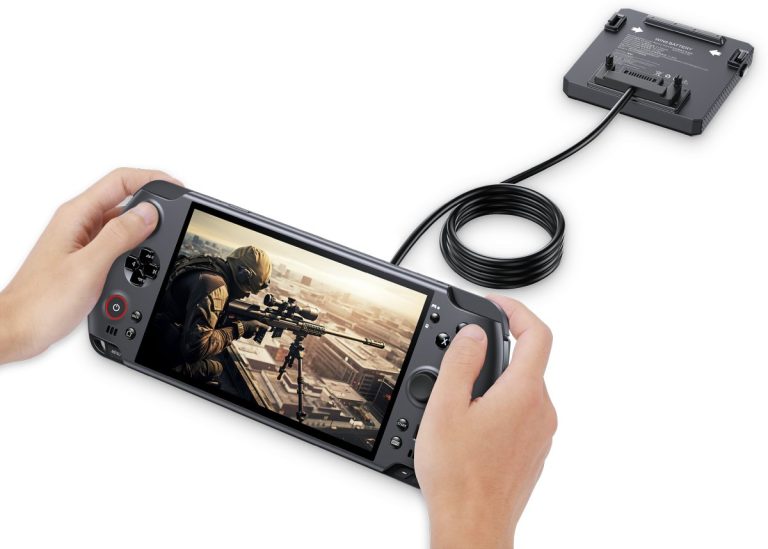
The GPD Win 5 is the most powerful handheld gaming PC to date thanks to its AMD Strix Halo processor that features an integrated GPU that delivers discrete graphics-class performance. It’s also the most expensive handheld gaming PC to date.
GPD has been talking about the upcoming handheld for months, and now the company is taking pre-orders through an Indiegogo crowdfunding campaign, with reward levels starting at $1448 for a model with an AMD Ryzen AI Max 385 processor and 32GB of RAM, or $1650 for a Ryzen AI Max+ 395 model.

Those prices are marked down from estimated retail prices that will start at $1600 and $1850, respectively after the GPD Win 5 begins shipping in November, 2025. Those are high prices for a handheld, especially at a time when you can pick up a Steam Deck LCD for as little as $320. But it’s an unsurprising price when you consider that you can’t even find a desktop computer with an AMD Strix Halo processor that sells for less than $1100 at the moment.
But there’s no other handheld on the market (yet) that offers the kind of performance you can get from the Win 5. Early reviews suggest it offers PS5 Pro-level performance in a handheld form factor. And there have been plenty of third-party reviews that show AMD’s Strix Halo processors offers discrete-class graphics, even if most of the PCs powered by these chips so far have been positioned more as AI workstations than gaming systems.
The AMD Ryzen AI Max 385 is an 8-core, 16-thread processor with Radeon 8050S graphics featuring 32 RDNA 3.5 GPU compute units, while the Ryzen AI Max+ 395 has 16 CPU cores, 32 threads, and Radeon 8060S graphics with 40 RDNA 3.5 CUs.

That chip can run at the same kind of low power settings as other recent AMD processors, enabling reasonable battery life for less demanding games. But the chips really shine when you increase the power levels – in the GPD Win 5, AMD’s processors support up to a 75 watt TDP for folks that are willing to sacrifice battery life for bleeding edge performance.
The handheld supports USB-C chargers, but for the best performance while plugged in, you’ll want to use the 180W power supply that comes with the Win 5.
GPD made the unusual decision to use an external battery pack instead of a built-in battery for the Win 5. While you can clip the included 80 Wh battery to the back of the handheld, there’s also an extender cable that allows you to keep the 350 gram (12.3 ounce) battery in your pocket while gaming, making the GPD Win 5 a little lighter to hold in your hands.

This design also makes it possible to purchase multiple batteries and swap them out without stopping to plug the handheld into a power source, which could theoretically extend the amount of time you can use the device while away from a wall jack or power bank. GPD is offering spare batteries for $93 each during crowdfunding, marked down from a $103 retail price.
There’s also a dock accessory that sells for the same price, giving you a charger, stand, and a set of ports that includes USB-C, USB 3.2 Gen 2 Type-A, Ethernet, and HDMI 2.1 ports, as well as a battery charging slot that lets you recharge a spare battery and a Win 5 at the same time (or independently of one another.
GPD’s handheld is also one of the first to support mini SSD cards, which combine the read/write speeds of an SSD with the convenience of removable storage cards.
All told, this thing is a very powerful handheld… that’s also likely to be a very niche product due to its high cost.
Here’s an overview of some key specs:
| GPD Win 5 (Ryzen AI Max+ 395) | GPD Win 5 (Ryzen AI Max 385) | |
| Display | 7 inches 1920 x 1080 pixels 120 Hz |
|
| Input | Touchscreen Optical sensor for finger/mouse input Joysticks |
|
| Processor | AMD Ryzen AI Max HX 395 16 x Zen 5 / 32 threads Up to 5.1 GHz 50 TOPS NPU 45-75W TDP |
AMD Ryzen AI Max 385 8 x Zen 5 / 16 threads Up to 5 GHz 50 TOPS NPU 45-75W TDP |
| Graphics | AMD Radeon 8060S 40 x RDNA 3.5 compute units Up to 2.9 GHz |
AMD Radeon 8050S 32 RDNA 3.5 compute units Up to 2.8 GHz |
| RAM | 32 or 64 GB LPDDR5x-8000 (256GB/s bandwidth) |
|
| Storage | 2TB or 4TB PCIe 4.0 NVMe SSD (M.2 2280) microSD card reader |
1TB PCIe 4.0 NVMe SSD (M.2 2280) microSD card reader |
| Battery | 80 Wh (external) | |
| Charging | 180W DC power jack | |
| Ports | 1 x USB4 (40 Gbps) 1 x USB 3.2 Gen 2 Type-C (10 Gbps) 1 x USB 3.2 Gen 1 Type-A (10 Gbps) 1 x mini SSD 1 x microSD card slot 1 x 3.5mm audio jack |
|
| Wireless | WiFi 6 Bluetooth 5.2 4G LTE (optional) |
|
| Audio | Stereo speakers 3.5mm audio jack built-in mic |
|
| Security | Fingerprint sensor | |
| OS | Windows | |
| Dimensions | 267 x 111.6 x 24.2mm | |
| Weight | 590 grams (without battery) 940 grams (with battery) |
|
| Starting price | $1650 (crowdfunding) $1850 (retail) |
$1448 (crowdfunding) $1599 (retail) |